From Silos to Synergy: Sleed’s Parallel Data & AI Transformation
Sleed delivered a parallel transformation of its data foundation and AI adoption, breaking down silos while building practical AI literacy across the organization. The result was faster decisions, major time savings, and near-universal daily AI use.
Key Results
Measurable impact and success metrics
From Silos to Synergy: the Parallel Data & AI Transformation of Sleed
Sleed
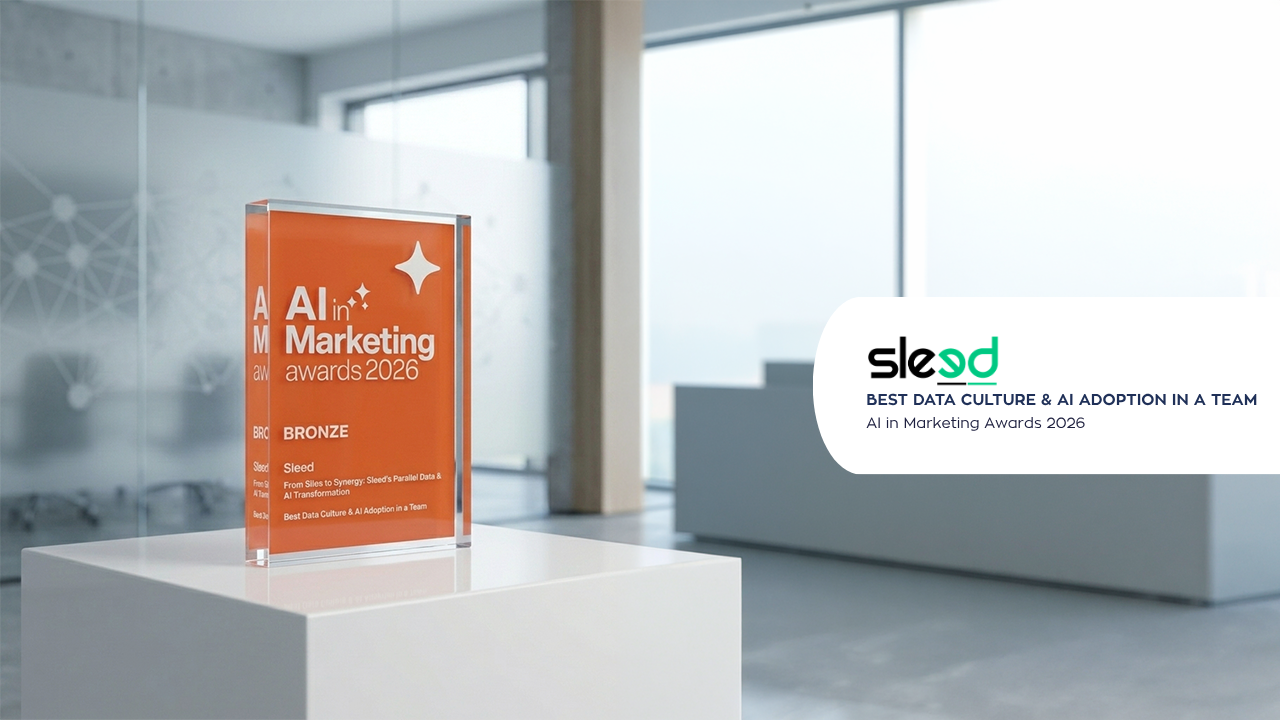
E-volution Awards 2026 — BRONZE: Best Data Culture & AI Adoption in a Team
| KPI / Metric | Result | Timeframe |
|---|---|---|
| Daily or near-daily AI adoption | 96% (from 30%) | Apr 2023 → Q3 2025 |
| Employees who rate AI as critical | 47% | By Q3 2025 |
| Time saved | 40+ hours/month | With AI-powered analysis & automated reporting |
| Speed of RFM interventions | 4x faster response | Quarterly manual → Daily automated |
| Market response time | From weeks to hours | With AI alerts in competitive monitoring |
“AI adoption fails when it is treated as a technology project and not as a cultural transformation. We need infrastructure, enablement, and measurement to create change that stands the test of time.”
The Case
In an era where AI is both the next big thing and a notorious buzzword, the core challenge for agencies is to cultivate genuine adoption that transforms operational capacity without sacrificing service quality. Sleed faced the classic Agency Paradox: how to pursue R&D and experimentation while operating under pressure from scale limitations, tight profitability margins, and continuous pressure for high client standards.
Implementation required coordinating two parallel streams: the Data Team builds the technical foundation for unified intelligence, and the AI Team develops the skills and behaviors needed to operationalize it.
The Challenge
The challenge was twofold: first, breaking down data silos that locked critical business intelligence inside disconnected systems (web analytics, ERP, competitive data, and external market signals). Second, accelerating AI proficiency from superficial tool use to deep, contextual integration across 160+ employees with different technical backgrounds and use cases.
Our goals
- Migration from siloed, manual reporting to a unified, AI-augmented decision-making infrastructure.
- Achieve >90% daily or near-daily AI adoption by 2025.
- Democratization of data insights through dashboards accessible to non-technical stakeholders.
- Deploy narrow AI agents for specialized strategic analyses.
- Develop sustainable AI literacy and maintain stable profitability throughout.
Our Approach
Unified Data Architecture
The Data Team implemented a single source of truth in Google BigQuery, unifying ERP (sales, logistics), web analytics, SimilarWeb, and open data sources. This eliminated silos, standardized definitions, and turned fragmented information into structured, queryable assets.
On top of this foundation, two AI-powered automation agents were developed:
- RFM Segmentation Agent: Runs daily in BigQuery, dynamically re-clustering customers and triggering personalized CRM interventions.
- Competition Analysis Agent: Monitors SimilarWeb & open data streams, detects anomalies in competitors’ behavior, and composes predictive alerts for leadership, reducing response time to hours.
Through Looker Studio dashboards, non-technical teams gained real-time visibility into customer lifecycles, product performance, and market shifts, significantly reducing analyst bottlenecks.
AI Enablement Framework
In parallel with the data infrastructure, we structured AI adoption around a three-pillar enablement framework to build literacy, confidence, and cross-team consistency.
-
Institutional Role Creation
We created a dedicated AI Project Manager to oversee R&D, education programs, and adoption metrics across all departments.
-
Systematic Education
AI Wiki (internal repository of tools, workflows, prompts, and best practices), role-specific workshops, AI Bi-weekly Newsletters (3 editions per business unit), and a dedicated AI for DM Team squad.
-
Continuous Measurement
Quarterly AI Adoption Surveys since April 2023 — a closed-loop mechanism where behavior, capability, and tooling co-evolve.
What We Achieved
The dual Data & AI transformation reshaped operations, decision-making, and Sleed’s internal culture, proving that innovation and performance can scale simultaneously when treated as interdependent disciplines.
- AI usage increased from 30% (April 2023) to 96% daily or near-daily by Q3 2025, with 47% of employees rating AI as critical to their work.
- AI usage shifted decisively toward strategic functions: Research (64% frequent use) and business writing (47%) surpassed copywriting (30%), signaling a move from content generation to analytical work.
- The unified BigQuery architecture eliminated the multiple truths problem. Looker Studio now functions as a live operations cockpit with real-time competitive monitoring and unified customer lifecycle views.
- AI-powered analysis and automated reporting freed up 40+ hours/month, reinvested into higher-value work.
- Dynamic RFM segmentation moved from quarterly manual analysis to daily automated interventions — a 4x faster response to behavioral signals.
- Competitive monitoring became genuinely reactive: AI alerts reduced market response time from weeks to hours.
- Throughout the transformation, profitability remained stable.
Key takeaway: We proved that data infrastructure without AI literacy is underutilized, and AI adoption without a data foundation is superficial. Our parallel transformation creates a replicable model for organizations facing the same challenges.
🥉 This initiative was recognized with a BRONZE award in the Best Data Culture & AI Adoption in a Team category at the E-volution Awards 2026 — confirming that when data infrastructure and AI literacy evolve together, results become measurable and durable.