
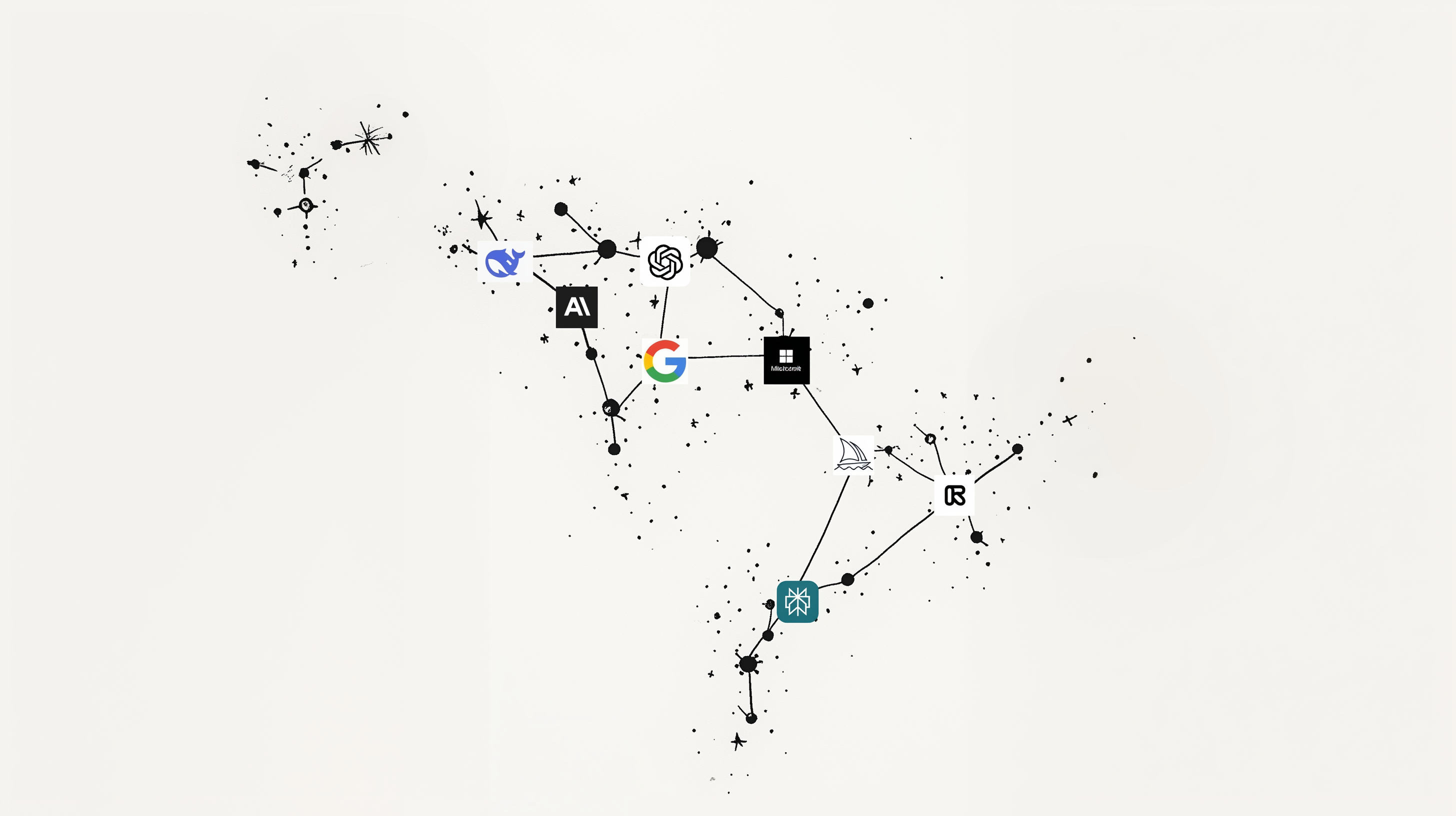
The year kicks off with a flood of new AI tools that are changing how we work and create. From China's DeepSeek, which has shaken up Silicon Valley, to Sora, which is transforming video production, and the inevitable moves by Microsoft and Google across their office suites, January 2025 proved that artificial intelligence doesn't take time off. These developments bring both opportunities and challenges for businesses and users worldwide.
DeepSeek: the Chinese AI revolution
In late December 2024, DeepSeek (an AI startup headquartered in Hangzhou, Zhejiang, China) created a near state-of-the-art model, DeepSeek-V3. A few weeks later, it introduced DeepSeek-R1, a competitive alternative to OpenAI's o1. Overnight, the company entered the big league alongside OpenAI, Google, and Anthropic-both in terms of performance and innovation. The model, which you can try for free here, achieved state-of-the-art results using just 2,000 Nvidia chips, with training costs of around $5.6 million - pocket change compared with the budgets of America's AI giants. The most impressive part? It is fully open-source, giving developers worldwide seamless access.
DeepSeek's success shows that the moat of American companies is disappearing and that LLMs are becoming dramatically cheaper. Nvidia's stock fell 17% on Monday 27/01, as DeepSeek demonstrated that massive chip clusters aren't required to train advanced models. Meanwhile, OpenAI responded by accusing DeepSeek of intellectual property infringement, and the Italian data protection authority suspended access to the model.
Sora: OpenAI's AI video generator
After extensive testing of the much-discussed Sora, reality proved more complex than the impressive demo videos. The AI video generator shows notable capabilities, but also significant limitations.
For example, its physics rendering is, surprisingly, better in 720p videos. Also, long prompts often lead to less satisfactory results. On the plus side, it supports Greek prompts-as long as you keep them short and clear. Compared with Runway's Gen-3 Alpha, Sora delivers competitive performance, especially in cinematic shots and portrait photography.
However, there are major credit-management issues: Plus users can't purchase additional credits, and unused credits don't roll over to the next month. If you're on ChatGPT Pro, "relaxed mode" is a lifesaver, as it allows video generation when credits run out during off-peak periods. As a result, in the landscape of AI tools for creators, Sora is powerful-but not a silver bullet.
Mandatory AI integration by Microsoft and Google
The two tech giants made decisive moves that redefine how we use office tools. Microsoft is adding Copilot to Microsoft 365 Personal and Family for an additional $3/month, while giving existing users the option to choose the new "Classic" plans without AI.
By contrast, Google is taking a more aggressive approach. It is adding Gemini to all Workspace Business accounts at a total cost of $14/month and is making the transition mandatory by March 17, 2025.
2025 will clearly be the year when the question won't be whether you use AI, but which AI you use. For Greek businesses, that means budgeting, user training, and security policies before adoption.
January 2025 showed that the race for new AI tools isn't confined to the U.S., but has a global dimension. From DeepSeek's Chinese innovation, to Sora's creative boundaries, and the strategies of Microsoft and Google, artificial intelligence is becoming an integral part of day-to-day work. For businesses, the key question isn't whether they will adopt AI, but how they will do so strategically and responsibly.