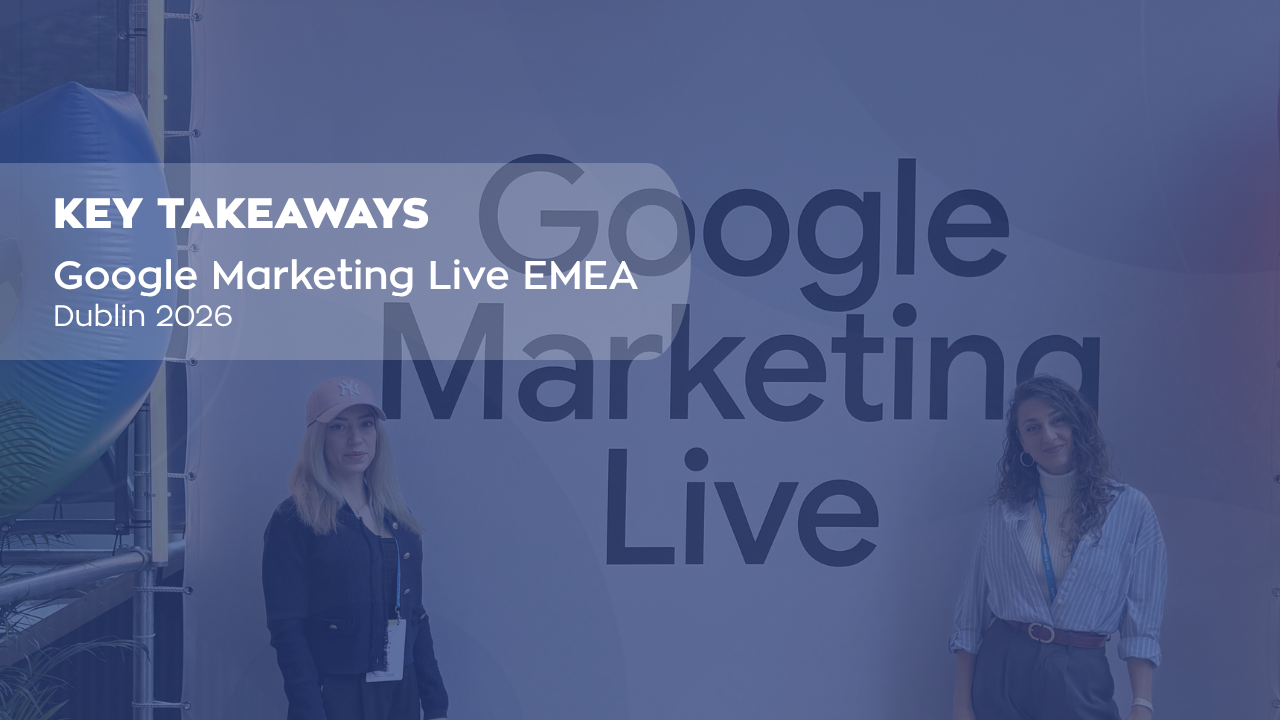
Google Marketing Live EMEA 2026: What it means for tomorrow’s marketing
Key takeaways from Google Marketing Live EMEA 2026, from AI-powered Search and YouTube Demand Gen to agentic commerce and next-gen measurement. What changes now is how marketers feed data, signals, and strategy into AI-first systems.
Google Marketing Live EMEA 2026: What it means for tomorrow’s marketing
Every year, Google Marketing Live is the event where you read the highlights and think “okay, interesting”. This year in Dublin, though, it was different. It was one of those times you leave and realize something truly changed — not in Google’s roadmap, but in the way you’ll think about marketing from here on out.
The Sleed team was there. And these are the 4 things we’re taking away.
1) Search: from performance channel to discovery engine
Search has always been the channel that captures demand. The user searches, you show up. Simple, effective, measurable.
The problem? That logic assumes the user already knows what they want when they open Google.
With AI Max and its expansion into Shopping and Travel Ads, Google is doing something far more ambitious: it wants Search to capture intent much earlier in the funnel, through natural, conversational questions. The user doesn’t need to know exactly what they’re looking for. AI predicts it and serves it up to them.
AI Brief, the new feature that allows advertisers to “talk” to the AI in their own words and guide strategy, is perhaps the most interesting detail. Because it gives control back to the marketer, but in an environment where AI does the heavy lifting.
What does this mean in practice? That Search campaigns won’t be built the same way anymore.
This opens up new possibilities — and new responsibilities — in how we structure bids, assets, and the signals we feed into the system.
2) YouTube: branding and performance together
In digital marketing, the “branding or performance” debate has become cliché. Everyone knows you need both. Few know how to make them work together.
Demand Gen changes that equation. Instead of waiting for the user to search for something, it leverages signals from Search, Maps, and YouTube to predict who will want your brand before they even start searching. It creates demand; it doesn’t just capture it.
The expansion into Google Maps and the new Product Feed surfaces mean YouTube gains even more touchpoints. And improved attribution means you can finally measure what you always knew worked, but couldn’t prove.
What do we take away? That YouTube is no longer “the channel for brand video.” It’s a complete performance ecosystem — as long as you treat it that way.
- Creator assets
- Data connection
- Attribution
Those are the three things that make the difference.
3) Commerce: friction is over
This is perhaps the most radical of the 4 takeaways.
The way we shop online has a few steps we take for granted: I see something, I search, I compare, I click, I buy. The Universal Commerce Protocol and the agentic commerce Google presented want to erase all of those steps.
The user discovers a product inside an AI-driven conversation in Gemini, in AI Mode, and can buy instantly, without leaving. A single, secure flow from curiosity to checkout.
For brands that have invested in strong Merchant Center feeds and product data, this is an opportunity. For those that haven’t, it’s a wake-up call. Because if the user is buying inside the conversation, then visibility there becomes the new digital shelf.
The takeaway? Merchant Center and data quality are no longer back-office topics. They’re front-line marketing.
4) Measurement: from reporting to growth engine
Last, but perhaps the most actionable.
Google presented a new logic for measurement — not as results reporting, but as a decision-making tool. Google Analytics as a Data Command Center, integrating Data Manager and Meridian. Google tag gateway for data strength. Causality signals feeding into MMMs.
The essence? It’s no longer enough to know what happened. You need to know why it happened and be able to use it to make better decisions about the budget you invest.
This requires clean data and proper source connectivity, and people who know how to read the signals — not just produce reports.
For us at Sleed, this isn’t new. It’s how we’ve been working for years. But it’s good that the tool now supports it better.
The common thread
If there’s one thing that connects all 4 takeaways, it’s this: AI isn’t a feature — it’s infrastructure. It’s not something you switch on and see what happens. It’s now the way every channel operates, and the question isn’t whether you’ll use it, but how well you’ll feed it with the right data and signals.
That means better feeds, cleaner data, more strategic thinking about what you provide to the system. And it means the marketer’s role isn’t shrinking — it’s becoming more demanding.
Want to apply this to your own brand?
Get in touch with us.